
info@oceanuswave.com
sales@oceanuswave.com
Clinical Application of Oceanus ETUS-001 Dual-Frequency Therapeutic Ultrasound System
Overview
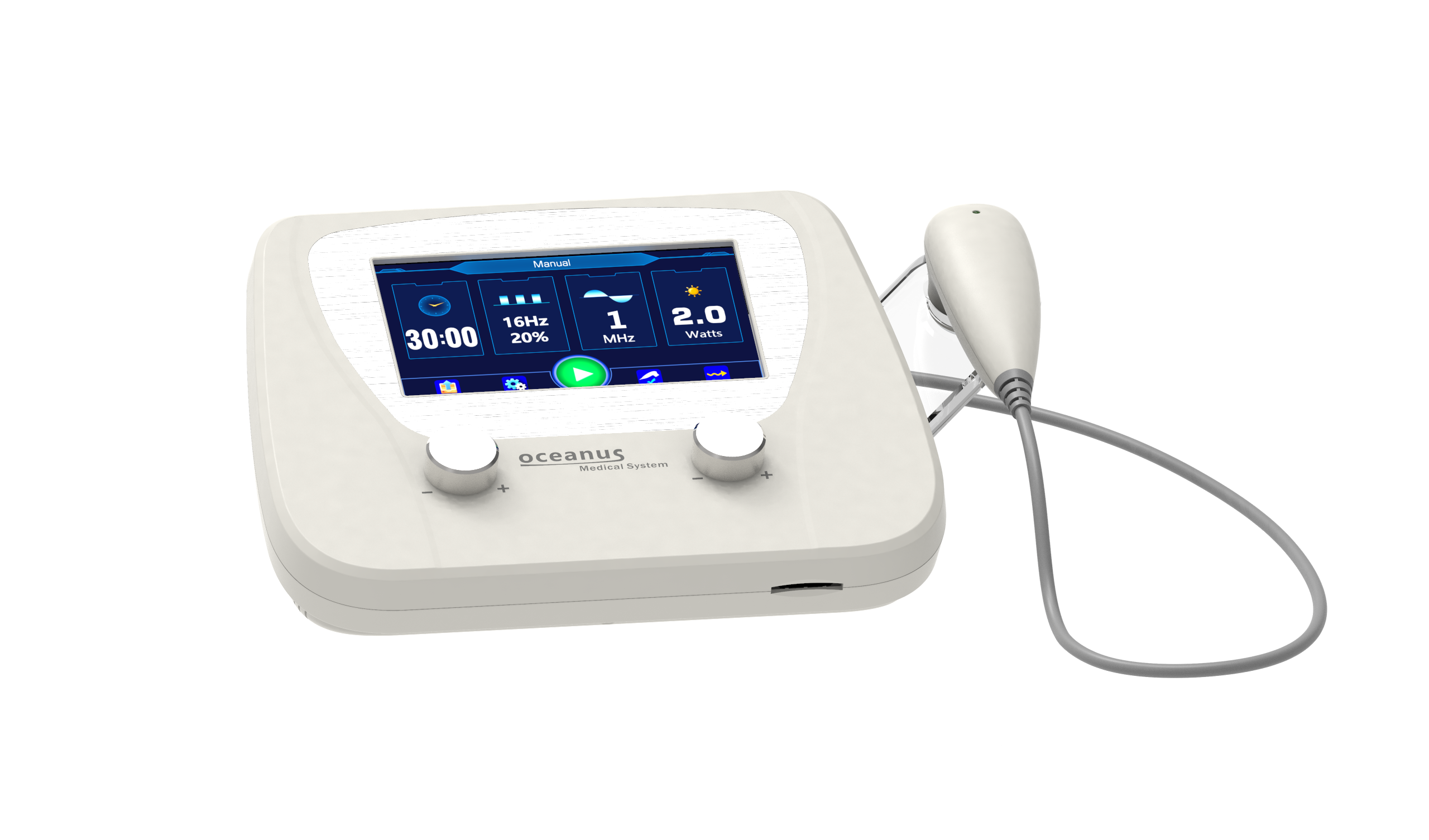
ETUS-001 is a tabletop dual-frequency therapeutic ultrasound system equipped with a piezoelectric ultrasound transducer, supporting switchable 1 MHz / 3 MHz therapeutic frequencies for musculoskeletal physiotherapy. The 1 MHz ultrasound delivers deeper tissue penetration to target deep tendons, muscle bellies and joint capsules. The 3 MHz ultrasound attenuates rapidly, concentrating energy within superficial soft tissues from 0.5 cm to 2 cm, including superficial fascia, tendon sheaths and subcutaneous tissue. The integrated dual-frequency design enables parameter individualization according to lesion depth, catering to stratified rehabilitation management for acute, subacute and chronic soft tissue injuries. It is widely deployed in sports medicine departments, rehabilitation medicine units and specialized physiotherapy clinics.
Mechanism of Action
The biological effects of therapeutic ultrasound arise from the combined action of mechanical, thermal and cavitation effects:
Mechanical Vibration Effect: Micro-oscillation generated by ultrasound reduces the viscous resistance between collagen fibres, releases scar and fascial adhesions, improves soft tissue extensibility, lowers muscle spindle excitability and relieves skeletal muscle spasm.
Thermal Effect: Absorption of acoustic energy converts into heat, elevating tissue temperature, dilating microcirculation and facilitating clearance of inflammatory metabolites. Continuous mode produces prominent thermal effects, while pulsed mode minimizes temperature rise to avoid overheating in acute injuries.
Stable Cavitation Effect: Controlled oscillation of cavitation bubbles under appropriate acoustic intensity increases cell membrane permeability, modulates fibroblast activity and promotes ordered collagen remodelling to accelerate soft tissue repair.
Indications
Sports-related soft tissue injuries: muscle strain, soft tissue contusion, tendinopathy, tenosynovitis and bursitis.
Chronic musculoskeletal pain: myofascial pain syndrome, periarticular soft tissue adhesion of shoulder, residual chronic pain after ankle sprain.
Postoperative scar and adhesion management: hypertrophic scar and soft tissue adhesion after orthopaedic surgery, for limitation of joint range of motion.
Degenerative osteoarthropathy complicated with periarticular soft tissue inflammation and pain.
Contraindications
Lesion sites with malignant tumour, active infection, broken skin or suppurative inflammation are contraindicated.
Thrombotic regions and sites with severe peripheral vascular disease are contraindicated.
Direct application to eyes, thyroid, gonads, lower abdomen of pregnant women and areas with implanted cardiac pacemakers is strictly prohibited.
Ultrasound irradiation over epiphyseal growth plates is forbidden in adolescents with unfused epiphyses.
Caution is required for patients with impaired cutaneous sensation; treatment intensity shall be reduced and close monitoring maintained.
Clinical Advantages of ETUS-001
ETUS-001 is equipped with a switchable 1 MHz / 3 MHz transducer, with selectable continuous / pulsed wave modes, adjustable output power and treatment duration to enable precise individualized intervention:
1 MHz: Effective penetration depth of 3–5 cm, targeting deep tendons and muscle tissues for chronic deep musculotendinous lesions.
3 MHz: Energy confined within superficial 0.5–2 cm tissue layer, suitable for superficial tenosynovitis, subcutaneous scars and superficial fascial lesions. It adopts a colour touchscreen interface with visualized parameters. Pulsed mode is indicated for acute injuries to limit thermal accumulation; continuous mode is applied for chronic soft tissue disorders to exert thermal therapeutic effects.
Clinical Operation Guidelines
Operators shall receive professional training for physiotherapy equipment, including lesion assessment, frequency selection, acoustic intensity setting and standardized application of coupling medium. The transducer must keep moving at a constant speed throughout treatment; static irradiation is prohibited to prevent thermal burns. Clinicians shall comply with therapeutic dose windows and continuously evaluate cutaneous sensation and patient response during treatment to adjust parameters accordingly.
Note: This device is a physical rehabilitation therapy device and shall not be used for disease diagnosis.
References
[1] Robertson VJ, Baker KG. A review of therapeutic ultrasound: effectiveness studies. Physical Therapy, 2001, 81(7):1339-1350.
[2] Watson T. Therapeutic ultrasound in soft tissue lesions. Manual Therapy, 2000, 5(4):204-213.
[3] O'Brien J. Therapeutic ultrasound for musculoskeletal conditions: a narrative review. Journal of Physiotherapy, 2010, 56(3):145-151.
[4] Baker K, Robertson V. Therapeutic ultrasound: mechanisms and clinical applications. Journal of Hand Therapy, 2002,15(2):147-155.
[5] Speed C. Therapeutic ultrasound in tendinopathy. British Journal of Sports Medicine, 2014,48(11):831-835.


EMAIL: info@oceanuswave.com sales@oceanuswave.com WEBSITE: www.oceanuswave.com
ADDRESS: No.2,East side,Floor 2, Yinjin Building, Liuxian Road 3, Xin'an Zone 71,Xin'an Subdistrict,Bao'an District, Shenzhen, 518101,Guangdong, P.R. China