
info@oceanuswave.com
sales@oceanuswave.com
Clinical Application of Oceanus EMST-001 Multi-Mode Electrical Stimulation Therapy System
Overview
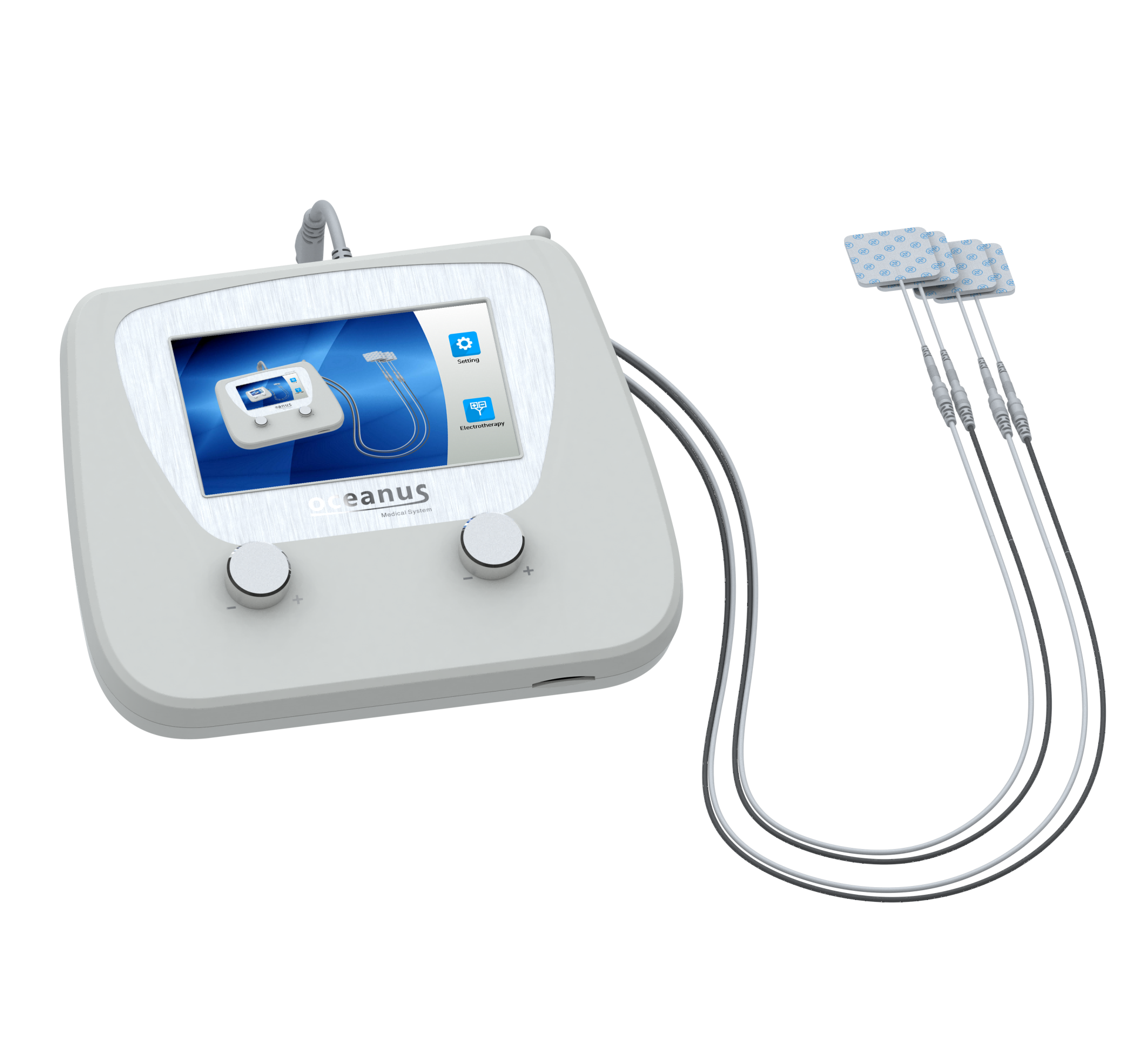
EMST-001 is a tabletop multi-mode electrical stimulation therapy system equipped with 5 types of waveforms: Bipolar interferential, Quadripolar vector interferential, TENS, EMS and Russian wave. Controlled low and medium-frequency electrical stimuli are delivered to neuromuscular tissues via surface adhesive electrodes. The system supports independent multi-channel output for simultaneous intervention on multiple target sites. Waveform selection, stimulation intensity and treatment duration can be individually adjusted. It is widely adopted in rehabilitation departments, sports medicine centers, post-orthopedic rehabilitation and pain clinics for neuromuscular function reconstruction and management of acute and chronic pain.
Mechanism of Action
Bipolar interferentialTwo sets of medium-frequency currents interfere within local tissue and generate low-frequency modulation. It overcomes epidermal impedance and acts on superficial and intermediate soft tissues, inhibiting nociceptors and improving microcirculation for superficial musculoskeletal pain.
Quadripolar vector interferentialFour electrodes generate a dynamically scanning interference electric field. The vector field can move to cover a larger volume of deep tissue, avoiding stimulation habituation at fixed points. It targets deep periarticular structures and paraspinal muscles for chronic deep pain and tissue oedema.
TENSBased on the gate control theory of pain, electrical stimulation activates Aβ afferent fibres to block nociceptive signal transmission at the spinal dorsal horn. It also triggers the release of endogenous opioids to achieve immediate and sustained analgesia for various acute and chronic soft tissue pain.
EMSElectrical pulses excite motor nerves and trigger rhythmic contraction and relaxation of skeletal muscle, preserving muscle fibre activity, preventing disuse atrophy after immobilization, improving local blood flow and reducing tissue oedema.
Russian waveMedium-frequency carrier wave modulates low-frequency pulses, greatly reducing skin impedance. The current penetrates deep into muscle belly to induce forceful muscle contraction with minimal cutaneous stinging, indicated for muscle strengthening and post-exercise muscle recovery.
Indications
Acute and chronic pain management: neck, shoulder and low back pain, myofascial pain syndrome, pain associated with osteoarthritis, post-surgical pain and soft tissue pain after sports injury.
Muscle rehabilitation: disuse muscle atrophy after immobilization, reduced muscle strength post-stroke, muscle activation and relaxation before and after exercise.
Tissue oedema and circulatory disorder: adjuvant intervention of soft tissue oedema after trauma to improve local microcirculation.
Skeletal spasticity management: mild to moderate muscle spasm, assisting to reduce muscle tone and improve range of motion.
Deep arthrogenic pain: vector interferential for deep soft tissue pain of lumbar spine, hip and knee joints.
Contraindications
Patients with implanted cardiac pacemakers, implantable defibrillators or other implanted electronic devices are contraindicated.
Application over malignant lesions, active infection, broken skin or eczematous dermatitis is prohibited.
Stimulation on carotid sinus, head and face, precardiac region and abdomen of pregnant women is strictly forbidden.
Caution for patients with severe peripheral neuropathy or complete loss of skin sensation, as they cannot detect excessive stimulation leading to tissue injury.
Contraindicated for patients with severe epilepsy or cognitive impairment unable to cooperate.
Clinical Advantages of EMST-001
EMST-001 integrates 5 professional therapeutic waveforms: Bipolar interferential, Quadripolar vector interferential, TENS, EMS, Russian wave. Independent multi-channel output enables synchronized or separate treatment on multiple sites:
Bipolar interferential: Simple operation for superficial and intermediate pain;
Quadripolar vector interferential: Dynamic vector electric field covering large deep tissue volume;
TENS: Fast analgesia for acute and chronic pain;
EMS: Muscle maintenance and rehabilitation to prevent disuse atrophy;
Russian wave: Deep muscle strength training, ideal for sports rehabilitation.
It adopts a colour touchscreen with physical adjustment knobs for visualized parameters. Pre-set evidence-based clinical protocols and customizable parameter storage support personalized rehabilitation plans for patients at different injury stages. Non-invasive treatment with adhesive surface electrodes for convenient clinical operation.
Clinical Operation Guidelines
Operators shall receive professional training in electrophysical agents, including electrode placement, waveform selection and stimulation intensity titration. Assess skin integrity and sensory function before treatment to rule out contraindications. Ensure full adhesion of electrodes to avoid focal current burns. Increase stimulation intensity gradually and continuously monitor patient feedback. Inspect skin for redness or irritation after treatment.
Note: This device is a physical rehabilitation therapy device and shall not be used for disease diagnosis.
References
[1] Johnson, M. I. (2021). Transcutaneous electrical nerve stimulation (TENS) for chronic pain. Cochrane Database of Systematic Reviews.
[2] Alon, G. (2003). Electrical stimulation of skeletal muscle: principles and applications in rehabilitation. Journal of Neurologic Physical Therapy, 27(2):68-79.
[3] Cameron, M. H. (2019). Physical Agents in Rehabilitation: An Evidence-Based Approach to Practice. 5th ed. Elsevier.
[4] Ward, A. R., & Shkuratova, N. (2002). Russian electrical stimulation: the early experiments. Physical Therapy, 82(10):1019-1030.
[5] Goats, G. C. (1990). Interferential current therapy. British Journal of Sports Medicine, 24(2):87-91


EMAIL: info@oceanuswave.com sales@oceanuswave.com WEBSITE: www.oceanuswave.com
ADDRESS: No.2,East side,Floor 2, Yinjin Building, Liuxian Road 3, Xin'an Zone 71,Xin'an Subdistrict,Bao'an District, Shenzhen, 518101,Guangdong, P.R. China